
How can we design better aftercare?
(2025)
Fabric+ has worked to understand the needs, challenges, and opportunities present in young adults' transition from child welfare to aftercare, with particular emphasis on collaboration between services and the interplay between professional support and young people's relational networks.
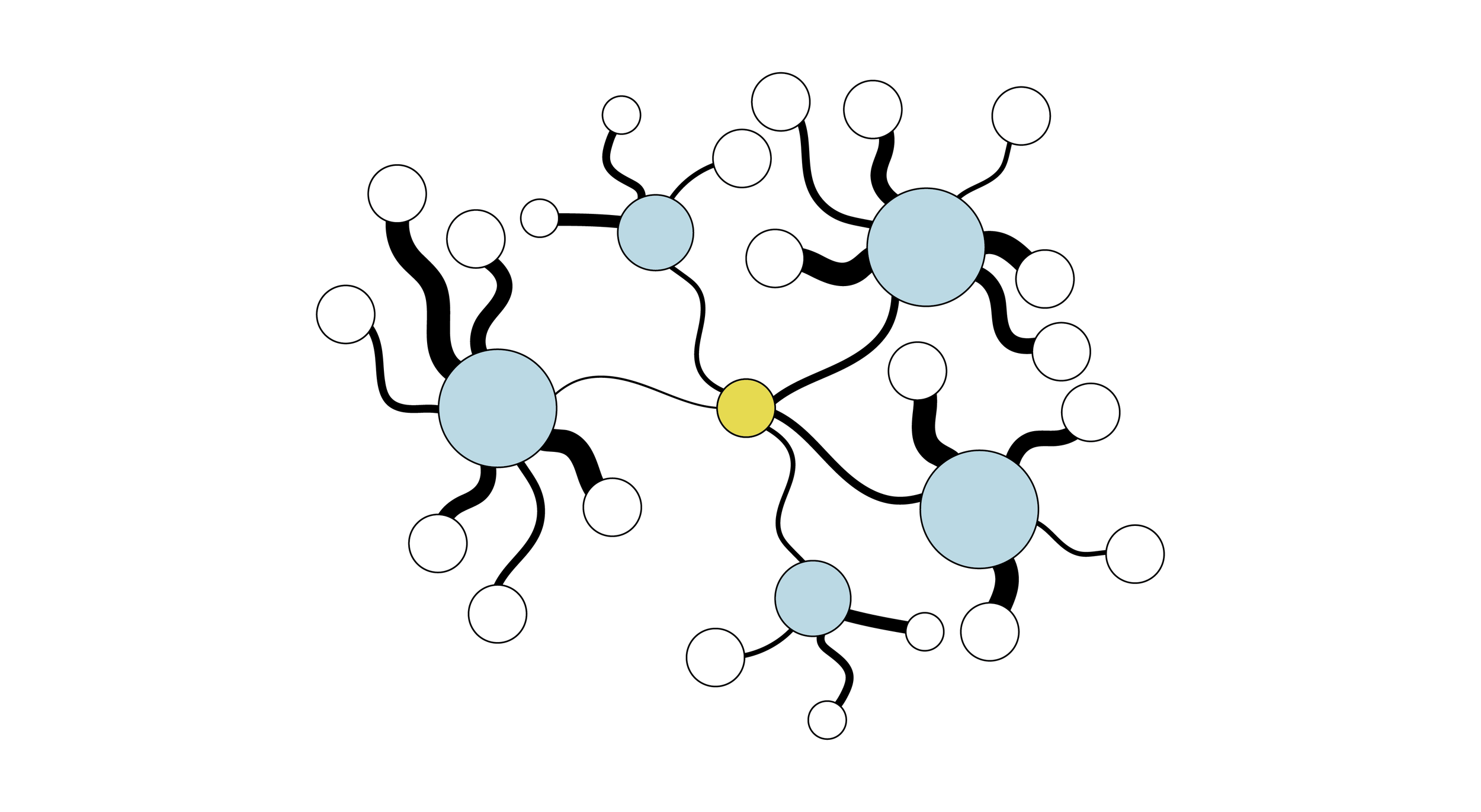
Figure: In aftercare cases, one advisor (yellow) has multiple young adults (blue) at the same time. In practice, it becomes challenging for the young adults to become independent if the advisors lack adequate tools to make the existing relationships around the young adults sustainable.
Information
The work has resulted in an insights report featuring 33 insight cards spanning seven themes, each with an associated opportunity space.
The main insight of the report is that aftercare in practice functions as a complex service ecosystem, rather than a delimited offering upon turning 18. The transition to adult life is less about age alone, and more about simultaneous changes in relationships, roles, expectations, and support. When these changes are not coordinated across services, young adults experience increased insecurity, loneliness, and uncertainty about what they can expect from the system.
The report shows that the goal of independence is often misunderstood as a requirement to stand alone. For young adults in aftercare, independence is more about having a voice, being taken seriously, and being part of relationships that can withstand strain over time. The insights also point to the fact that the experience of feeling valuable and necessary — of being needed — is crucial for a meaningful adult life, and that this cannot be safeguarded by professional services alone.
Aftercare works best when there is continuity in a secure relationship, whether from a follow-up worker, an outreach service, or in other cases — NAV employees.
The report reveals significant expectation gaps between the services that make up aftercare. Different mandates, capacities, and working methods often only become visible to young people after leaving child welfare, which can lead to disappointment, loss of trust, and increased strain on both the young person and the services. A lack of shared language, limited continuity in relationships, and varying degrees of realism regarding the number of relationships services have capacity for, all reinforce these challenges.
Taken together, the insights indicate that the potential for better aftercare does not primarily lie in more measures, but in better coherence: between services, over time, and between professional support and young people's social networks. Aftercare works best when understood as relational transition work, in which both young adults and services are supported in navigating change in ways that strengthen security, belonging, and sustainable relationships.
For Samskaping i Vest and Brobyggerne, the report provides an insights foundation for further work at the interfaces between services. The insights show that aftercare is an area particularly well suited for co-creation, where shared understanding, expectation alignment, and new ways of working can be explored across organizational boundaries.
Deliverables:
How can we design better aftercare?: Insights Report (NO)
Client:
Helse Vest, through Samskaping i Vest and Brobyggerne
Partner:
Trude Senneseth, project manager for Samskaping i Vest
Location:
Askøy and Øygarden municipalities
Fabric+ services:
Systems-oriented design
Organizational development
Visualization
Lead: Siri Arntzen-Ratnarajan