
Harstad Municipality: Safer Outdoor Spaces in Winter
(2025)
In Phase 2 of our project Ageing in the Arctic, we received together with Harstad municipality 1.3 million in funding for an innovative research and innovation project aimed at making cities and communities safer and more inclusive for older people — especially during the winter months.
Information
Ageing in the Arctic – Innovative Fall Prevention is a design and service design project in Harstad. It examines how surroundings, transport, winter maintenance, and social infrastructure affect older people's safety and participation — and tests concrete measures that can make a real difference. The project is carried out by Harstad municipality in collaboration with Fabric+/AT Arkitektur and Troms County Authority, funded by Troms Holding.
Project Goals
A solid local evidence base. Harstad has lacked a systematic overview of falls since 2015. This project has resumed the work of establishing an updated and locally grounded knowledge base.
More targeted measures. Knowledge about where and how falls occur provides a basis for prioritizing interventions where the need is actually greatest.
Better resource allocation. Effective prevention is not necessarily about increased resources, but about better decision-making foundations and strengthened cross-sectoral collaboration.
More sectors involved in the work. Winter maintenance, property owners, transport, and voluntary organizations are key actors in fall prevention. The project has helped to activate and connect these more closely.
Reduced social isolation as an objective. Winter conditions affect not only the risk of falling, but also participation and activity. The measures therefore also aim to make it easier to get out and take part in everyday life.
A lasting learning structure. Methodology, data, collaborative approaches, and insights have been developed so that the work can be continued and further developed after the project period.
Background
Winter in the north is demanding, and in Harstad it is both long and unpredictable. Temperatures around zero degrees bring frequent shifts between snow, rain, ice, and bare surfaces. Pavements can appear safe but be slippery. At the same time, steep terrain and dispersed settlement mean that many people have long distances to services and meeting places.
For older people with reduced balance, without a car or social support, this can make it difficult to get outside. Many choose to stay at home.
The risk of falling is 5–11 times higher on ice and snow than on bare surfaces. The consequences are not only about the fall itself, but also about reduced activity and social participation over time. This can weaken both physical and mental health, and increase the risk further.
A large part of the risk lies in the environment: winter maintenance, accessibility, transport, and social structures. These factors cut across sectors and require a broader effort.
Harstad is well equipped — but has lacked data
In 1994, Harstad became the first municipality in Norway to be approved in the WHO network for Safe Communities. For over 30 years, the municipality has worked systematically and cross-sectorally on injury prevention.
In 2015, systematic registration stopped. Key personnel left, the system was deprioritized, and eventually it no longer existed. The municipality still had the will and structure for prevention — but lacked the local knowledge about where and how accidents actually occur.
Without data, we cannot prioritize. Without prioritization, we act randomly. This project was created to close that gap — and enable Harstad to prevent falls as precisely as they once did.
Results
Re-established Harstad's fall data foundation for the first time since 2015. A GIS-based registration system and a baseline survey now provide a local and repeatable knowledge base for fall prevention.
Identified concrete risk areas and tested measures in real winter conditions. Including Normanns gate and Hvedings gate, where measures were developed and trialed based on actual incidents.
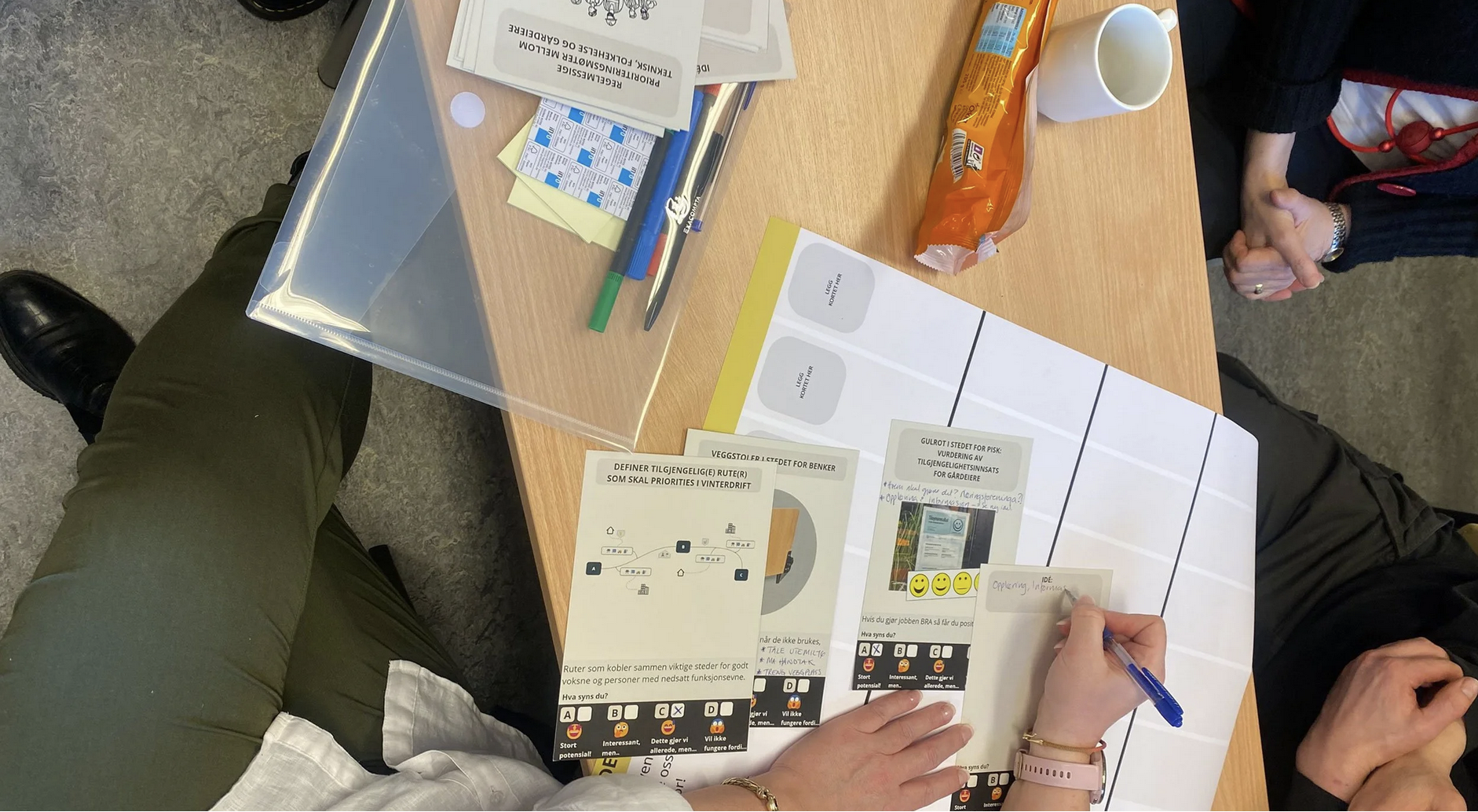
Developed and tested five cross-sectoral prototypes. Including on-demand transport, a fixed route (senior bus), physical measures in outdoor areas, and a model for collaboration with property owners.
Established a new collaboration model with property owners. A "living guide" and annual meeting structure contribute to increased awareness, clearer responsibilities, and better coordination of winter maintenance.
Strengthened cross-sectoral collaboration. Actors within winter maintenance, transport, voluntary organizations, and public health are more closely connected in the work on fall prevention.
Documented what works — and what does not. The project has provided concrete knowledge about the effect of measures, including the limitations of certain solutions.
Developed a methodology that can be continued and transferred. The working approach — from insight and prioritization to prototyping and evaluation — is documented and can be used in further work in Harstad and other municipalities.
Keywords
#Innovation #RegionalDevelopment #Space #BusinessDevelopment #SystemsOrientedDesign
Deliverables: Insights Report, Final Report, and Action Plan
Client: Harstad Municipality
Partners: Harstad Municipality, Troms County Authority, funded by Troms Holding
Location: Harstad / Troms / Norway
Fabric+ services:
Regional development
Process management
Lead: Siri Arntzen-Ratnarajan